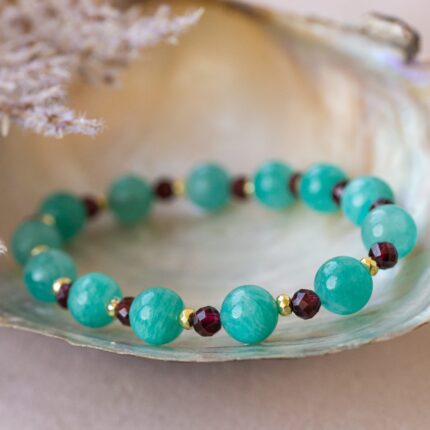
Ruby & Apatite Bracelet – Limited Edition

CHF 79
Ruby & Apatite Bracelet
Give free rein to your creativity and express your individuality through these one-of-a-kind pieces.
1 in stock
Standard delivery or recorded delivery.
Click & Collect
Available within 1 to 2 working days.
- Cornavin Shop
- Balexert Shop
Delivery within Europe
CHF 10.- for delivery within Europe, excluding Switzerland.
For further information, please see our terms and conditions for delivery terms.
Back
Return period: 14 days.
Product information
| Size | 18 cm |
|---|---|
| Bead diameter | approx. 4–6 mm |
| Thread | Elastic silicone |
Description
Ruby & Apatite Bracelet – ARIA
Symbolism of the Ruby: Creativity – Energy – Passion
Symbolism of the Apatite: Creativity – Communication – Knowledge
Our Limited Edition bracelets:
Discover our Limited Edition creations, featuring a blend of semi-precious stones.
The delicate details of our bracelets highlight the natural beauty of the minerals.
Each of these bracelets has been carefully crafted to bring harmony and refined elegance.
Give free rein to your creativity and express your individuality through these one-of-a-kind pieces.
Wear them individually for a subtle touch or layer them to create a personalised look.
Gold-plated haematites add a touch of sparkle.
The ruby:
The name ‘ruby’ derives from the Latin ‘rubeus’, meaning ‘red’.
It is a red gemstone belonging to the corundum family. Its colour is due to the presence of chromium.
Rubies have been mined in Burma (now Myanmar) for over 2,000 years. The Mogok mines in Burma are renowned for producing some of the world’s finest rubies.
In India, the ruby is known by the Sanskrit names ‘ratnaraj’ or ‘king of gemstones’.
It is also known as ‘Ratnanayaka’, which means ‘leader of gemstones’.It was believed that its colour reflected the presence of an unquenchable inner fire.
In Christian tradition, the ruby is associated with the symbolism of the blood of Christ and was even used to adorn cardinals’ rings until the Second Vatican Council.
It is also mentioned in the Qur’an.
Other red gemstones have long been passed off as rubies, as evidenced by the story of the Timur Ruby.
In reality a red spinel, this 361-carat gem is set in the throne of the Mughal Emperor Akbar. Its eventful history is linked to Imperial India and the Kingdom of England.
The main ruby deposits are found in Myanmar, Thailand, Sri Lanka, Cambodia, Mozambique, Tanzania, Vietnam, Afghanistan and Pakistan
Apatite:
The name ‘apatite’ comes from Ancient Greek. It derives from the word ‘apataneo’, which means ‘to deceive’ or ‘to trick’.
Apatite was so named because of its similarity to other valuable minerals such as barite, peridotite and others.
Blue apatite belongs to the apatite group, which consists mainly of calcium phosphates. The blue colour of this variety is due to the presence of metals such as iron.
Blue apatite crystals form in a variety of geological environments, notably in phosphate deposits and sedimentary rocks.
Apatites are frequently found in iron ore deposits, which poses a major challenge to the steel industry.
This is because the phosphorus present in iron ores is entirely transferred into the metallic phase, making its removal during the steel refining process costly.
The main deposits of blue apatite are found in Brazil, Mexico, Myanmar, Sri Lanka and the United States.
Similar products you might like