

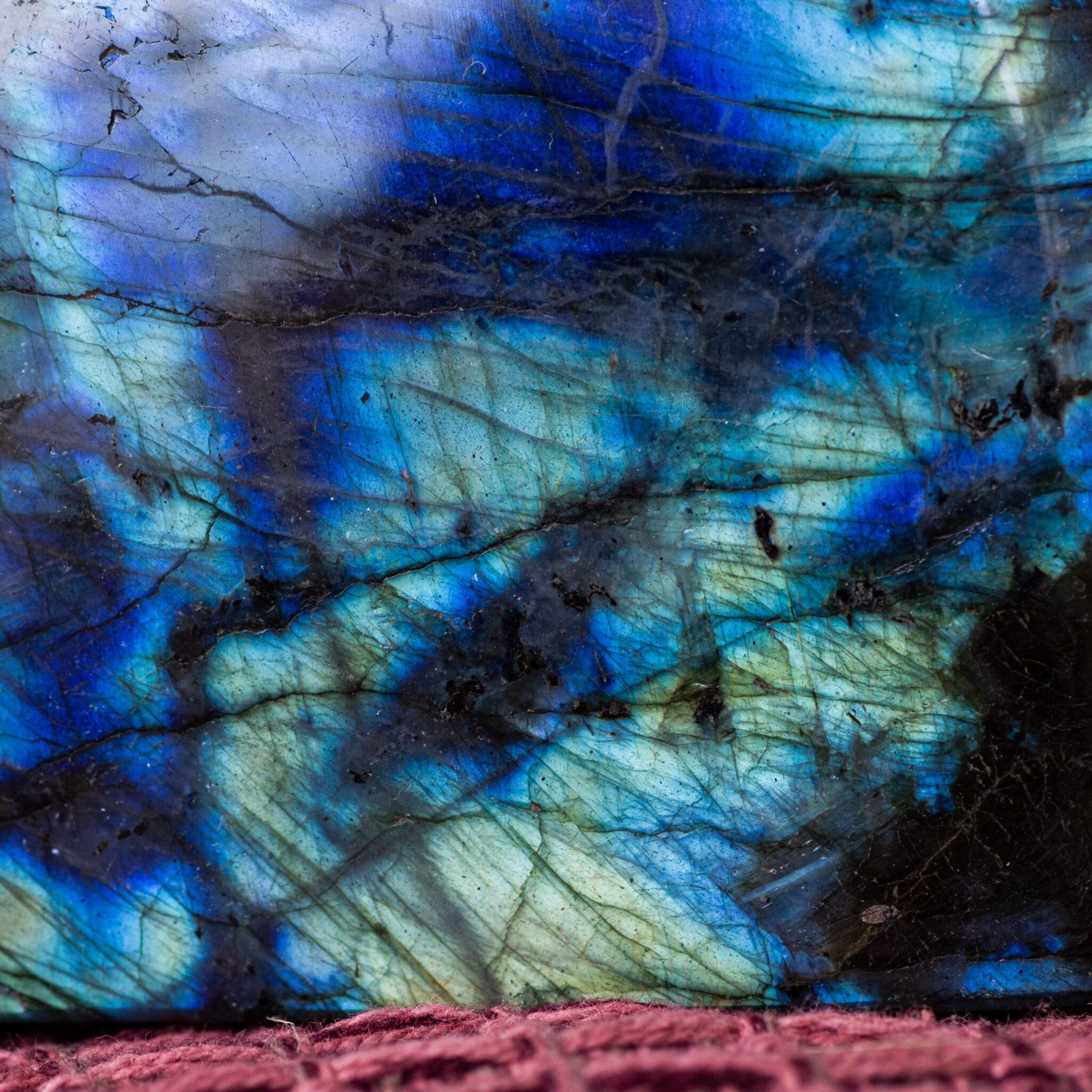


Blue Labradorite

CHF 150
Blue Labradorite
Our cut stones are a must-have to enhance your mineral collection!
Out of stock
- Its hardness makes it relatively durable, but do take care to protect your labradorite from knocks. We recommend that you remove your jewellery before taking part in any physical activity
- Labradorite can get wet; however, we recommend that you do not leave it submerged for long periods or in salt water
- Avoid contact with corrosive products, such as detergents and other household products that could damage it
- Store your jewellery in a dry place, away from light and heat
- There are several ways to cleanse your stones; please see here: caring for and cleansing semi-precious stones
Standard delivery or recorded delivery.
Click & Collect
Available within 1 to 2 working days.
- Cornavin Shop
- Balexert Shop
Delivery within Europe
CHF 10.- for delivery within Europe, excluding Switzerland.
For further information, please see our terms and conditions for delivery terms.
Back
Return period: 14 days.
Product information
| Dimensions | approx. 7.5 x 6.5 cm |
|---|---|
| Symbol | Intuition, Protection, Transformation |
Description
Blue Labradorite
Cut stones:
Our cut stones are a must-have to enhance your mineral collection!
These stones are carved to showcase their natural beauty and add a touch of elegance to your home.
Each piece is unique and reflects the diversity of nature.
Labradorite:
Labradorite is a stone much prized for the beauty of its play of colours.
It belongs to the feldspar family, more specifically to the plagioclase sub-category.
Feldspars are a group of rock-forming minerals that are among the most abundant in the Earth’s crust.
Its composition is complex, but its colours are due to sodium and calcium.
The most remarkable characteristic of labradorite is its adularescence, a phenomenon that produces a shimmer beneath the surface of the mineral.
Thanks to adularescence, labradorites display a wide variety of coloured reflections that become apparent when the stone is turned in the light.
The colours generally range from blue to green, with shades of yellow, orange and purple.
Labradorite takes its name from the Labrador region of Canada, where it was first discovered.
The main deposits of labradorite are found in Canada, Madagascar, Finland, Russia, Norway and the United States.
Similar products you might like


