
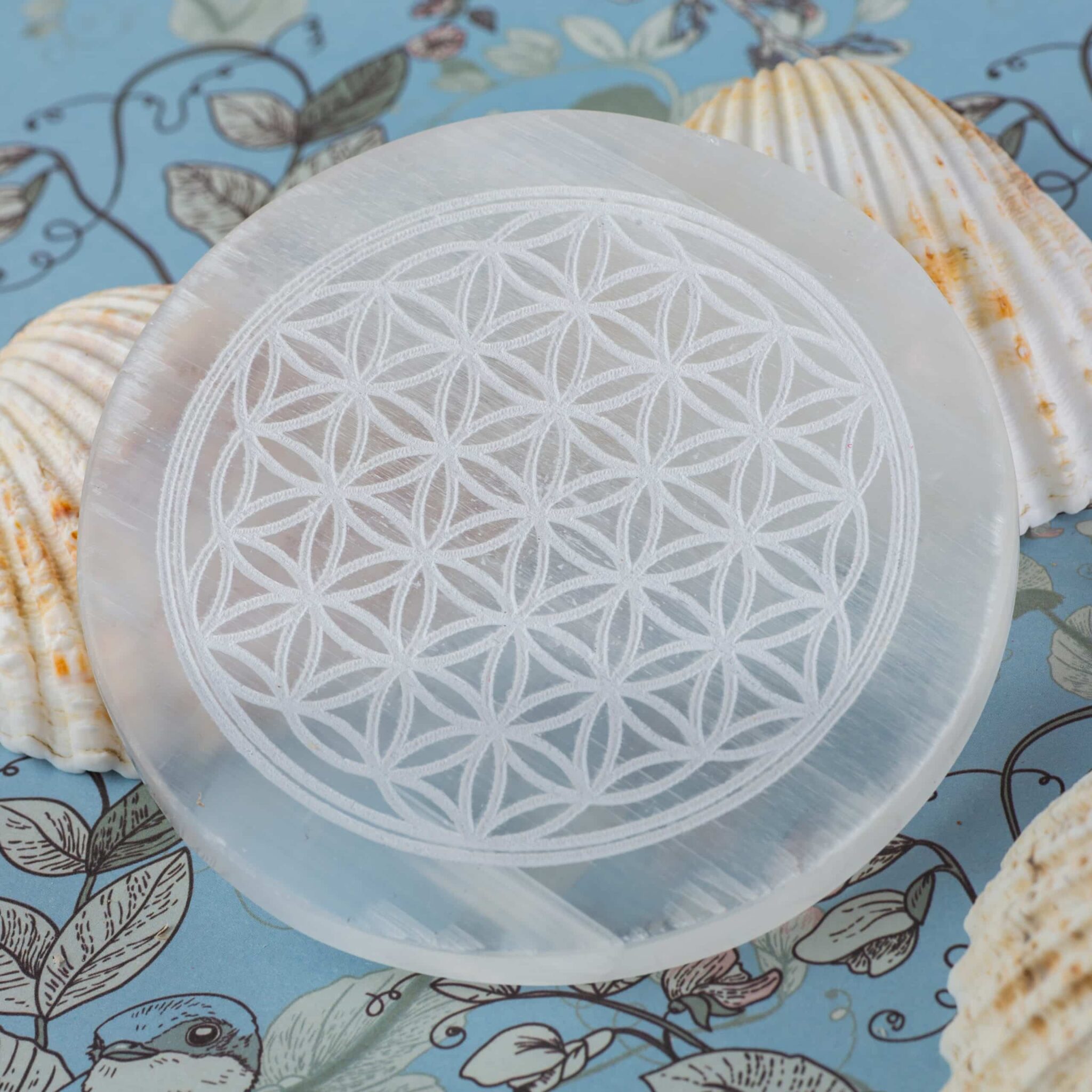
What is the Flower of Life? Origin and meaning
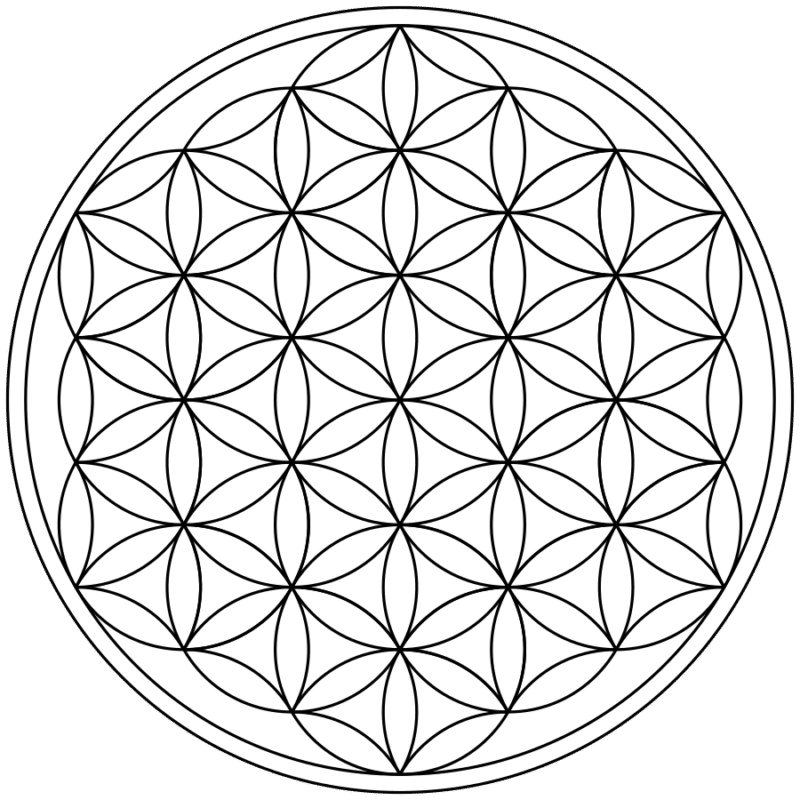
If you are interested in spirituality, crystal healing or sacred geometry, you cannot fail to come across the Flower of Life. This ancient symbol, composed of several overlapping and intersecting circles, forms a unique floral pattern whose geometric perfection has fascinated humankind since time immemorial.
This sacred symbol can be found engraved on the stones of the world’s oldest temples, from ancient Egypt (in the Temple of Osiris at Abydos) to Asia, via medieval Europe. For the ancients, the Flower of Life was not merely a decorative design: it represented the matrix of the universe, the original blueprint for all forms of life on Earth.
What are the benefits of the Flower of Life in everyday life?
In terms of energy, the Flower of Life is regarded as a generator of positive waveforms. It acts as a shield and a powerful harmoniser of the atmosphere within your home.
Harmonisation and purification of energies
The Flower of Life’s high vibrational frequency enables it to transmute low or stagnant energies. Placed in a living room, an office or a bedroom, it harmonises the atmosphere, reduces stress in the surrounding area and promotes restful sleep by clearing away negative energy.
Recharging stones and crystals
This is one of its most sought-after uses in crystal healing. Thanks to its perfect geometry, the Flower of Life emits a constant vibration that purifies and recharges the minerals placed at its centre. It restores the crystals’ full vibrational power without you needing to pay attention to the lunar cycles or the use of water.
Selenite:
What is selenite?
Selenite takes its name from Selene (Σελήνη) in Ancient Greek, meaning ‘moon’. Latin later borrowed this word to form the term ‘selenitis’, referring to a type of transparent limestone with a bluish sheen. The name was officially given by the mineralogist J.G. Wallerius in 1747, in his work *Mineralogia, eller Mineralriket*. Originally, it referred to one of the transparent varieties of gypsum, but through commercial usage, the term has now come to describe satin spar, which is pearly white in colour.
Gypsum forms in evaporitic environments — shallow marine basins, salt lakes, sebkhas, or underground cavities fed by mineral-rich water. As the water evaporates, calcium sulphate becomes supersaturated and begins to crystallise. Satin spar, more specifically, forms as veins within sedimentary rocks, through precipitation from solutions flowing through fractures. The most significant deposits are found in Mexico, Morocco, Canada, China, Italy, Greece, Brazil and the United States.
Please note:
- ⚠️ Like all varieties of gypsum, satin spar is soluble in water over time and extremely brittle. Prolonged exposure to moisture causes damage.
- ⚠️ Selenite does not contain selenium. The two names simply share the same Greek root, selḗnē (σελήνη), meaning ‘Moon’.
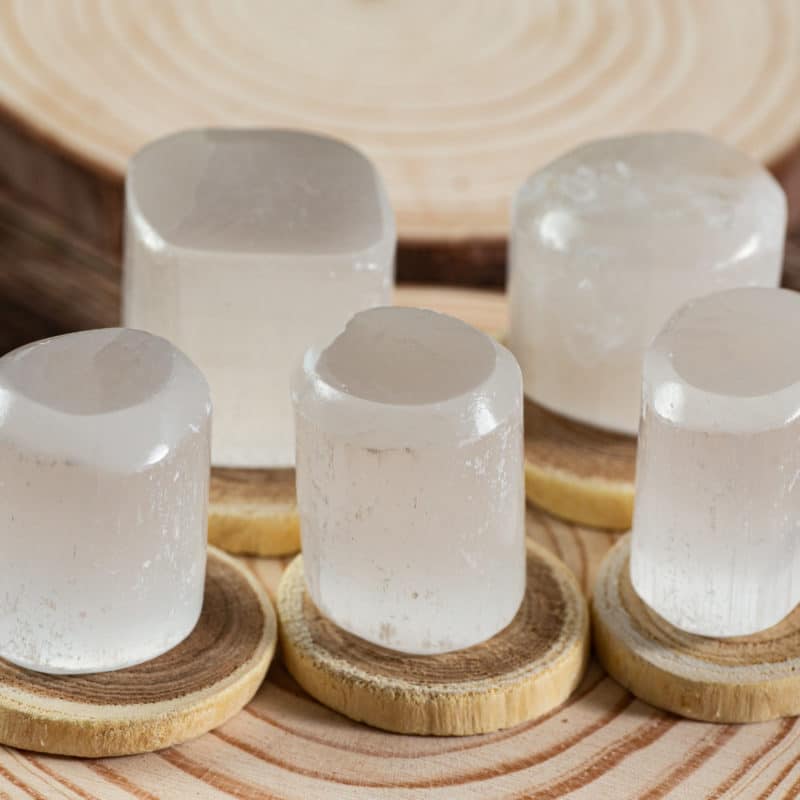
Selenite in Crystal Healing
It is considered one of the few stones that does not need to be cleansed itself, as it recharges naturally in the moonlight, and is used as a recharging tool for all other crystals used in crystal healing. Simply place other crystals on a tray or next to a piece of satin spar for a few hours to ‘purify’ them. It is associated with the crown chakra and the third eye, and is said to facilitate deep meditation, intuition and spiritual receptivity.
Why combine the Flower of Life with selenite?
Combining the geometric power of the Flower of Life with the exceptional vibrational properties of a crystal is the ultimate way to amplify its effects. And amongst all minerals, there is one that resonates in perfect harmony with this symbol of purity: selenite. Discover how this stone of the spirit and lunar clarity multiplies the magic of the Flower of Life tenfold…
How do you use the Selenite Flower of Life?
Simple instructions: Simply place your stones or jewellery in the centre of your selenite Flower of Life. Leave them there for at least 2 to 3 hours (or overnight). Thanks to the combined action of sacred geometry and the vibrations of selenite, your minerals will regain their full energetic potential, with no risk of damage.
Recharging Guide: Why is the Selenite Flower of Life universal?
Selenite is a stone with energy-purifying properties. When combined with the Flower of Life, it offers a 100 per cent dry and gentle method of purification and recharging, ideal for delicate minerals such as malachite, lapis lazuli or pyrite.
| Stone Type / Profile | Examples of Stones | Prohibited Methods | Benefits of the Selenite Flower of Life 🌟 |
|---|---|---|---|
| Stones that are sensitive to WATER (rich in iron or soluble) |
Malachite, Selenite, Pyrite, Haematite, Angelite, Cyanite | ❌ No water (risk of rust, discolouration or dissolution). | Completely safe: Recharging via form waves is a completely dry process. There is no risk of damaging the stone. |
| Stones that are sensitive to SUNLIGHT (which fade in the light) |
Amethyst, Rose Quartz, Fluorite, Celestine, Larimar | ❌ No direct sunlight (they will permanently lose their colour). | Zero discolouration: Gentle, lunar energy. Ideal indoors, in the shade, day or night. |
| ‘Sponge’ stones (which absorb negativity) |
Obsidian, Black Tourmaline, Labradorite | ⚠️ Require very frequent and labour-intensive cleansing. | Time-saving: Selenite is self-cleansing. Placing these stones on the Flower of Life allows for continuous, effortless cleansing. |
| Jewellery and small stones (bracelets, rings, etc.) |
All jewellery used in crystal healing | ❌ Water and salt damage elastic bands, threads and settings (silver/gold). | Convenience: Simply lay the bracelet flat on the selenite every evening to find it re-energised in the morning. |


