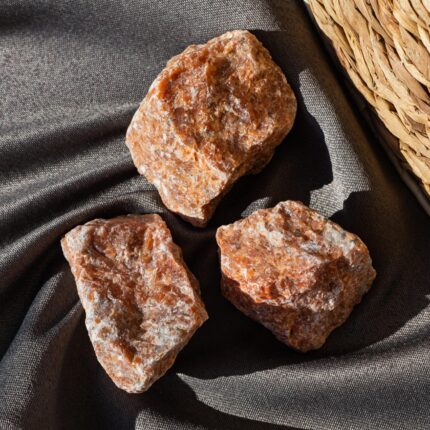
Raw black obsidian stone

CHF 24
Black Obsidian
Raw stones are unpolished, unprocessed minerals. They are authentic and full of character.
Sold individually.
Out of stock
Standard delivery or recorded delivery.
Click & Collect
Available within 1 to 2 working days.
- Cornavin Shop
- Balexert Shop
Delivery within Europe
CHF 10.- for delivery within Europe, excluding Switzerland.
For further information, please see our terms and conditions for delivery terms.
Back
Return period: 14 days.
Product information
| Dimensions | 7–8.5 cm |
|---|---|
| Symbol | Anchoring, Protection, Purification |
Description
Raw Black Obsidian:
Sold individually.
Raw stones:
Each rough stone is a unique piece from the Earth, retaining its natural beauty, ready to be discovered.
Raw stones are unpolished and unprocessed minerals. They are authentic and full of character.
They come in a variety of shapes, colours and textures and reflect the geological diversity of the Earth. These mineral treasures are extracted from natural deposits around the world.
Whether for meditation, interior decoration or to expand your mineral collection, you’re sure to find something to your liking in our online shop.
Black obsidian:
It is named after Obsidius, a figure from ancient Rome who, according to Pliny the Elder, is said to have discovered this stone for the first time.
Obsidian is a glassy volcanic rock, formed from rapidly cooled lava. It is also known as volcanic glass.
Its colour varies depending on the minerals and impurities present during its formation.
Specimens range from black to brown, including shades of green, red, gold and silver.
Obsidian is formed during eruptions from silica-rich lava, which cools so rapidly that crystals do not have time to form.
Unlike minerals, obsidian is an amorphous rock, meaning it has no crystalline structure.
This process gives obsidian its glass-like texture, enabling it to be cut into sharp edges.
This quality meant that obsidian was used by indigenous peoples to make tools and weapons such as knives, arrowheads and axes.
Geologists study obsidian to gain a better understanding of past volcanic eruptions.
Chemical analysis of obsidian can reveal information about a region’s geological history.
The main obsidian deposits are found in the western United States, Japan, Turkey, Iceland and Mexico.