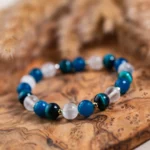
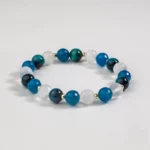
Blue Agate, Selenite & Blue Tiger’s Eye Bracelet – BLUEBERRY
CHF 49
Handcrafted in our Geneva workshop with natural gemstones. Each piece is one of a kind, a unique expression of the stones’ natural beauty.
Bracelet Size Guide


Measuring your wrist: Use a flexible tape measure, or a piece of string and a ruler. Wrap it around your wrist. This is your base measurement. On average, bracelet sizes are 18 cm for women and 21 cm for men.
Bead size: If your bracelet has beads of 10 mm or more, add 1-2 cm to your usual size.

Need a different size? If your bracelet is not the right size, we can adjust it free of charge in our workshop. Simply send it back to us by post, telling us what you need changed. Any extra stones required may be charged separately.
Every Sudamerica Stones bracelet is strung by hand in our Geneva boutiques, with each bead hand-picked for its beauty. We use a silicone cord chosen for its flexibility and strength, and guarantee it against breakage for one year. As every stone is unique, the bracelet you receive may look slightly different from the photos: it’s the sign of a truly natural piece.
Standard delivery or recorded delivery.
Click & Collect
Available within 1 to 2 working days.
- Cornavin Shop
- Balexert Shop
Delivery within Europe
CHF 10.- for delivery within Europe, excluding Switzerland.
For further information, please see our terms and conditions for delivery terms.
Back
Return period: 14 days.
Product information
| Size | 18 cm |
|---|---|
| Bead Size | 8mm |
| Stringing Material | Silicone stretch cord |
Blue Agate, Selenite & Blue Tiger’s Eye Bracelet – BLUEBERRY
Gold-plated haematite and lava beads add a touch of sparkle.
Blue agate: dyed stone
Blue tiger’s eye: dyed stone
Symbolism of Selenite: Purification – Spirituality – Sleep
About agate
Agate is a variety of microcrystalline quartz, admired for its endless range of colours and patterns. It forms slowly inside cavities in volcanic rock, where silica-rich water deposits layer upon layer of mineral, creating its characteristic concentric bands. Traces of other minerals give each agate its own colours, from white and grey to blue, red, brown and black. Main deposits: Brazil, Uruguay, Madagascar, India and the United States.
About selenite
Selenite is a transparent to milky variety of gypsum, a calcium sulphate. Its name comes from the Greek selene, “moon”, a nod to its soft, pearly lustre. Selenite is very soft – it can be scratched with a fingernail – and dissolves in water: keep it dry and simply wipe it with a soft cloth. Main deposits: Morocco, Mexico and Brazil.
About tiger’s eye
Tiger’s eye is a variety of quartz known for its silky, shifting sheen – called chatoyancy – reminiscent of a feline’s eye. It was long thought to form when quartz replaced fibres of crocidolite; we now know that it grows in cracks in the rock that open and fill again and again, with quartz and mineral fibres growing together, layer by layer. Oxidised iron then gives them their golden-brown colour. Main deposits: South Africa, Australia, Myanmar and India.
Similar products you might like