Is your baby teething, and are you looking for a natural way to ease their discomfort? Amber necklaces are often presented as a remedy for teething pain. But do they really work, and are they safe?
Before you decide, it’s worth knowing where they come from, what is claimed about them and which precautions to take. This guide covers everything you need to make an informed choice.
What is an amber teething necklace?
An amber teething necklace is made of small beads of amber, a fossilised tree resin. Many parents choose it for the soothing effects traditionally attributed to it.
📜 Origins and tradition
Amber has been used in folk medicine for centuries, and tradition credits it with calming and soothing properties. Amber necklaces are particularly popular in Eastern Europe and Germany.
🍯 Why amber?
Baltic amber contains succinic acid, a natural compound. According to popular belief, it is released on contact with the skin and helps to relieve pain and irritability during teething.
🔧 Handmade with care :
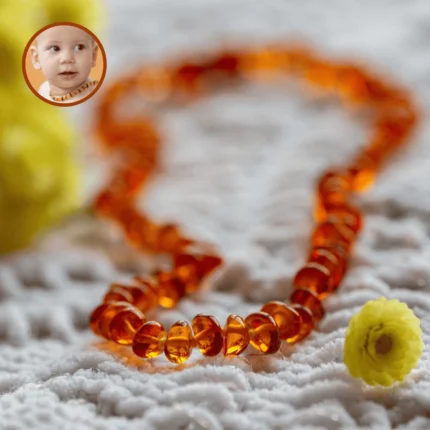
Amber teething necklaces are made from raw or polished beads. Each bead is knotted individually, so that if the necklace breaks, the beads don’t scatter.
- Raw amber: a natural, matt finish
- Polished amber: a smooth, glossy finish
- Fastening: usually a screw clasp or a safety clasp
Choosing a well-made necklace is essential for your baby’s safety

The claimed benefits of amber teething necklaces
Many parents turn to amber necklaces for their reputed benefits, particularly during teething.
A natural option for teething
Teething can be a difficult time for babies, and many parents look for ways to soothe their child’s irritability and tears. Amber necklaces are often seen as a natural alternative to teething gels.
According to tradition, amber has anti-inflammatory properties, and the succinic acid released on contact with the skin has a soothing effect.
Where style meets tradition
Beyond its reputed benefits, an amber necklace is also loved for its beauty. Available in a range of colours and bead shapes, it is as pretty as it is meaningful.
In some cultures, giving a baby an amber necklace is a time-honoured tradition. Like a lucky charm, it symbolises protection and security.
A natural, authentic material
Amber has been prized for centuries. As a natural material, it appeals to parents who prefer to avoid synthetic products for their baby.
Whatever you choose, make sure the necklace is well made, with individually knotted beads and a reliable clasp.
🔬 What does science say?
Amber necklaces are a popular way to soothe teething babies, and many parents say they ease pain and irritability. But scientific research on the subject remains limited.
The succinic acid theory
Baltic amber does contain succinic acid, to which some attribute soothing and anti-inflammatory properties. The idea is that the warmth of the skin releases this compound, which is then absorbed by the body.
However, no study has shown that succinic acid can pass through the skin in large enough quantities to relieve pain. Laboratory tests have also found that amber does not release succinic acid at body temperature.
A placebo effect?
Parents who notice an improvement may be experiencing a placebo effect: because they trust the necklace, they are more likely to perceive their baby as calmer. Teething pain also naturally comes and goes, which can make any remedy seem to work.
⚠️ Safety: risks and precautions
Any necklace worn by a baby carries certain risks:
- Strangulation: the necklace can become caught or tangled, during sleep or play.
- Choking: if the necklace breaks, a bead can be swallowed or inhaled.
- Skin irritation: babies with sensitive skin may react to contact with the amber.
Precautions to take
To reduce the risks:
- Choose the right length: the necklace should sit close to the neck without being tight, so it can’t catch on anything.
- Check the quality: each bead should be knotted individually, so the beads don’t scatter if the necklace breaks.
- Never let your baby sleep in it: always remove it for naps and at night.
- Always supervise your baby: never leave them wearing the necklace unattended.
- Consider an anklet or bracelet: worn under clothing, it reduces the risk of strangulation, though the same precautions apply.
What do healthcare professionals say?
Paediatricians and health authorities, including the US Food and Drug Administration, advise against teething necklaces because of the real risk of strangulation and choking. To ease teething discomfort, they recommend chilled (not frozen) teething rings or gently massaging the gums with a clean finger.
📏 Comparing amber teething necklaces
Bead shapes and sizes
Amber teething necklaces come with beads in different shapes and sizes, which affect both comfort and style.
The most common shapes are:
- Round beads: smooth and comfortable to wear, they don’t rub against the skin.
- Baroque beads: irregular shapes with a more natural, authentic look.
- Flat beads: they lie closer to the skin and are barely visible under clothing.
Bead sizes also vary:
- Small beads (4–6 mm): lightweight and discreet.
- Medium beads (6–8 mm): a good balance between look and comfort.
- Large beads (8 mm and over): more eye-catching, but sometimes less comfortable.
The right choice depends on the comfort and style you’re looking for. Smaller beads are often preferred, as they’re lighter and more discreet.
Colours and origin
The amber used in teething necklaces comes mainly from the Baltic region, and is valued for its quality and its naturally high succinic acid content.
Its colour can also guide your choice:
| Colour | Characteristics |
| Honey | The most popular shade: warm and natural |
| Cognac | A deeper shade with a classic, elegant look |
| Butterscotch | An opaque, pale yellow, delicate and rare |
| Green | A rare and distinctive shade |
| Black | Elegant and mysterious, traditionally associated with protection |
Each shade comes from the impurities in the resin and the conditions in which the amber formed. Some people believe lighter shades contain more succinic acid, but there is no scientific evidence for this.
In the end, colour is mostly a matter of taste: some parents prefer soft, natural shades, while others go for darker tones for a bolder look.
Tips for choosing the right necklace
Choosing an amber teething necklace calls for a little care. Here are a few points to check to make sure it is safe and of good quality.
Checking that the amber is genuine
A genuine amber necklace must be made from natural amber, but some sellers offer imitations in plastic or synthetic resin. A few ways to spot them:
- The salt water test: dissolve plenty of salt in a glass of water and drop in a bead. Genuine amber floats, while most plastics sink.
- The friction test: rub a bead briskly on a cloth. Genuine amber may give off a faint resin scent.
- Buy from a specialist: a reputable retailer is the best guarantee of authenticity.
Choosing a safe necklace
Safety comes first. Check the following points:
- A secure clasp: a screw clasp holds firmly and is easy for you to undo.
- A knot between each bead: so the beads don’t scatter if the necklace breaks.
- The right length: between 30 and 35 cm, to reduce the risk of the necklace catching.
Choosing quality craftsmanship
A good amber necklace is carefully made. The beads should be well polished so they don’t irritate delicate skin, and each knot should be tied by hand. It’s also worth checking where the amber comes from: Baltic amber is renowned for its quality.
Thinking about your baby’s comfort
A necklace that is too tight or too heavy may bother your baby, so choose a light, flexible design. If you’re unsure whether a necklace is suitable, an anklet worn under clothing may be a better option.
Choosing 100% amber
Some necklaces include glass or plastic beads for decorative purposes. These add nothing and may be a sign of lower quality. A necklace made entirely of natural amber is the better choice.
Handmade in our workshop


Caring for your necklace
To keep an amber necklace looking its best:
- Clean it with lukewarm water and no soap, then dry it with a soft cloth.
- Keep it away from prolonged sunlight and heat, which can darken or crack amber.
- Remove it at bath time, so it keeps its shine.