






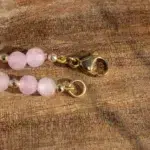
Kunzite & Pearl Necklace – AVRIL
CHF 95
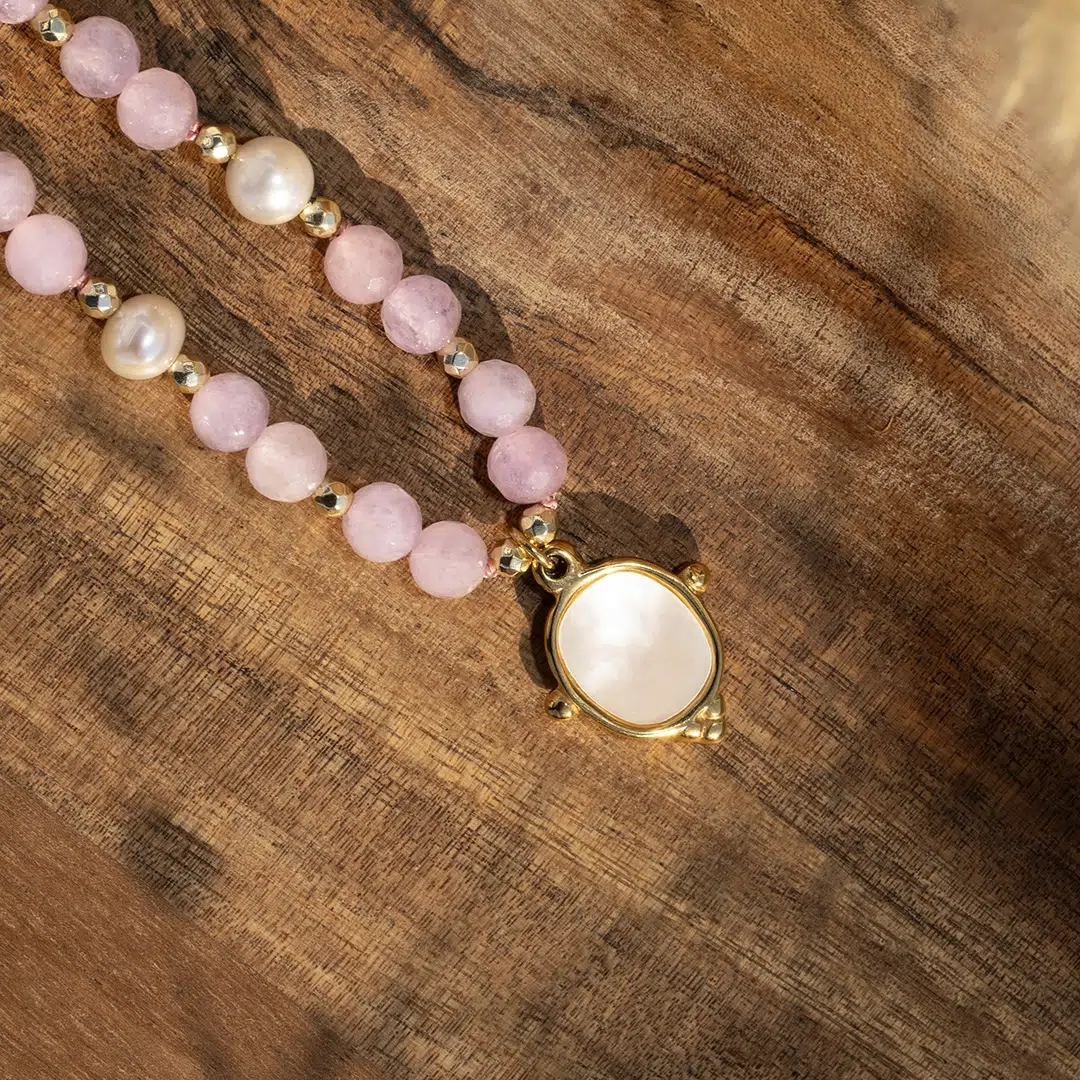
Handcrafted in our Geneva workshop with natural gemstones and cultured pearls. Each piece is one of a kind, a unique expression of their natural beauty.
1 in stock
Standard delivery or recorded delivery.
Click & Collect
Available within 1 to 2 working days.
- Cornavin Shop
- Balexert Shop
Delivery within Europe
CHF 10.- for delivery within Europe, excluding Switzerland.
For further information, please see our terms and conditions for delivery terms.
Back
Return period: 14 days.
Product information
| Length | 40 cm |
|---|---|
| Bead Size | 8mm |
| Stringing Material | Silk cord |
| Charm | 20 x 15 mm, Gold-plated steel, mother-of-pearl |
Kunzite & Pearl Necklace – AVRIL
Symbolism of Kunzite: Love – Gentleness – Positivity
Symbolism of Pearls: Purity – Spirituality – Gentleness
About kunzite
Kunzite is named after the gemmologist George Frederick Kunz, who first described it in 1903. A variety of spodumene, a lithium aluminium silicate, it forms elongated prismatic crystals. Its pink to violet colour comes from manganese, and its intensity depends on the amount present when the crystal formed. The name ‘spodumene’ comes from the Greek ‘spodoumenos’, meaning ‘reduced to ashes’, after the often greyish colour of the mineral. Kunzite can be phosphorescent, glowing briefly in the dark after exposure to ultraviolet light, but its colour may fade with prolonged exposure to sunlight. Main deposits: Brazil, Afghanistan, Madagascar and the United States.
About cultured pearls
Cultured pearls form inside molluscs such as oysters and mussels, after a nucleus or graft has been introduced by hand. The mollusc coats this foreign body with successive layers of nacre, also known as mother-of-pearl. Nacre consists of aragonite, a crystalline form of calcium carbonate, bound together by conchiolin, an organic protein. This combination gives pearls their strength and lustre. Their characteristic iridescent sheen, known as ‘orient’, comes from light diffracting through these layers. Their colour depends on the species of mollusc, the water conditions and the minerals present, ranging from pure white to pink, gold, grey and black. Main producers: Japan, China, Australia and French Polynesia.