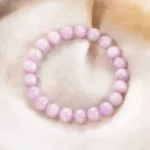


Kunzite Bracelet, 8mm
Price range: CHF 75 through CHF 79
A kunzite bracelet, handcrafted in our Geneva workshop using 8 mm beads strung on elastic silicone cord. Available in 18 cm and 21 cm.
Handmade in Geneva · 100% natural stone · Delivery to Switzerland & Europe
- Kunzite is a fairly hard stone, but it splits easily along its natural cleavage lines if knocked. Take your jewellery off before sport or any physical activity.
- Water won’t harm kunzite, so you can rinse it briefly to cleanse it.
- Take your jewellery off before swimming in the pool or the sea, as chlorine and salt can damage both the stones and the jewellery.
- Keep it out of the sun: UV light can fade its delicate pink colour.
- Keep it away from harsh chemicals such as detergents and household cleaners, which can damage the stone.
- Keep your jewellery somewhere dry, away from direct light and heat.
- There are several ways to cleanse and recharge your stones. Find out more in our guide: how to cleanse and care for your crystals
Every Sudamerica Stones bracelet is strung by hand in our Geneva boutiques, with each bead hand-picked for its beauty. We use a silicone cord chosen for its flexibility and strength, and guarantee it against breakage for one year. As every stone is unique, the bracelet you receive may look slightly different from the photos: it’s the sign of a truly natural piece.
Standard delivery or recorded delivery.
Click & Collect
Available within 1 to 2 working days.
- Cornavin Shop
- Balexert Shop
Delivery within Europe
CHF 10.- for delivery within Europe, excluding Switzerland.
For further information, please see our terms and conditions for delivery terms.
Back
Return period: 14 days.
Product information
| Sizes | 18 cm, 21 cm |
|---|---|
| Bead Size | 8mm |
| Stringing Material | Silicone stretch cord |
| Symbol | Gentleness, Love, Peace |
Kunzite Bracelet, 8mm
About kunzite
Kunzite is named after the gemmologist George Frederick Kunz, who first described it in 1903. A variety of spodumene, a lithium aluminium silicate, it forms elongated prismatic crystals. Its pink to violet colour comes from manganese, and its intensity depends on the amount present when the crystal formed. The name ‘spodumene’ comes from the Greek ‘spodoumenos’, meaning ‘reduced to ashes’, after the often greyish colour of the mineral. Kunzite can be phosphorescent, glowing briefly in the dark after exposure to ultraviolet light, but its colour may fade with prolonged exposure to sunlight. Main deposits: Brazil, Afghanistan, Madagascar and the United States.
Similar products you might like