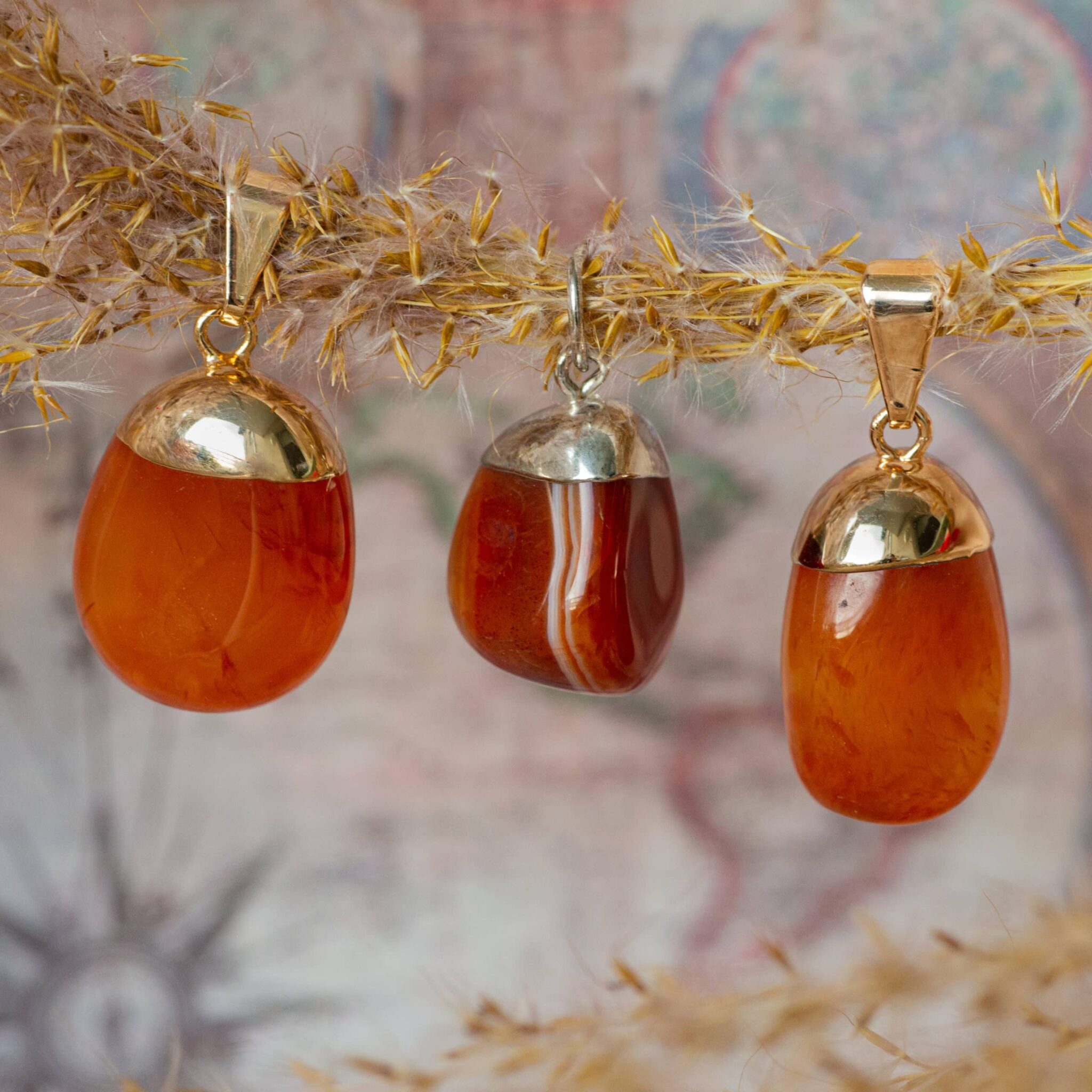


Carnelian Pendant
Price range: CHF 15 through CHF 34
A natural carnelian pendant, handmade in Brazil. Wear it on a leather cord or on your own chain – a simple, affordable way to keep your favourite stone close.
- Carnelian is a hard, hard-wearing stone, but a sharp knock can still chip it. Take your jewellery off before sport or any physical activity.
- Water won’t harm carnelian, so you can rinse it briefly to cleanse it.
- Take your jewellery off before swimming in the pool or the sea, as chlorine and salt can damage both the stones and the jewellery.
- Keep it away from harsh chemicals such as detergents and household cleaners, which can damage the stone.
- Keep your jewellery somewhere dry, away from direct light and heat.
- There are several ways to cleanse and recharge your stones. Find out more in our guide: how to cleanse and care for your crystals
Standard delivery or recorded delivery.
Click & Collect
Available within 1 to 2 working days.
- Cornavin Shop
- Balexert Shop
Delivery within Europe
CHF 10.- for delivery within Europe, excluding Switzerland.
For further information, please see our terms and conditions for delivery terms.
Back
Return period: 14 days.
Product information
| Stone size(s) | approx. 1 cm |
|---|---|
| Materials | Brass, Natural gemstones, Steel |
| Symbol | Courage, Creativity, Energy |
Carnelian Pendant
Part of our Budget-Friendly Gems selection: natural stone jewellery at affordable prices. The perfect way to choose your very first stone, add a new colour to your collection or find a thoughtful little gift.
Steel or gold-plated brass fittings. Available on its own or with a 45 cm leather cord and steel clasp.
About carnelian
Carnelian is a variety of chalcedony, a microcrystalline quartz, whose colour ranges from pale orange to deep reddish-brown thanks to iron oxide. Its name is thought to come from the Latin cornum, the cornel cherry. Carnelian was one of the most popular stones of the ancient world: in Mesopotamia and Egypt it was carved into seals, scarabs and amulets. Main deposits: India, Brazil and Uruguay.
Similar products you might like